Decodium Part 2: The Evolution from Decodium 3 Shannon to Decodium 4 Shannon
6/15/20263 min read
From Decodium 3 Shannon to Decodium 4 Shannon: The Evolution of a Digital Radio Platform
Introduction
The journey from Decodium 3 Shannon to Decodium 4 Shannon represents one of the most ambitious transformations in amateur radio software in recent years. While both versions share the same goal—pushing digital communications closer to the theoretical limits of signal decoding—they differ substantially in architecture, operating philosophy, user experience, and future ambitions.
Decodium 3 Shannon refined the highly regarded Raptor decoding technology and demonstrated that weak-signal performance could exceed the capabilities of many conventional digital-mode applications. Decodium 4 Shannon builds upon that foundation but expands the project into a comprehensive digital communications ecosystem rather than a specialized decoder.
The result is not merely a version upgrade; it is a generational redesign.
Architectural Transformation
The most significant difference between the two versions lies beneath the user interface.
Decodium 3 Shannon was built around a Fortran-based core, leveraging decades of proven digital signal-processing techniques. This architecture delivered excellent decoding performance but imposed limitations on future expansion and cross-platform development.
Decodium 4 Shannon was rewritten entirely in modern C++, utilizing Qt 6.11 and QML technologies. The new architecture introduces OpenMP-based parallel processing, allowing decoding workloads to be distributed across all available CPU cores. The only remaining Fortran components are specific LDPC routines retained for mathematical efficiency.
This redesign gives Decodium 4 significantly greater scalability and maintainability while creating a foundation for future development.
The Raptor Engine: Evolution Rather Than Replacement
One common misconception is that Decodium 4 abandoned the Raptor engine.
In reality, Decodium 4 inherits the Raptor technology from Decodium 3 and extends it. The newer version introduces enhanced multi-pass processing, best-of combining techniques, improved synchronization strategies, and expanded parallelization.
According to project documentation, Decodium 4 performs multiple independent decoding passes and selects the strongest results through a best-of methodology. This approach improves reliability under fading and interference conditions while preserving the weak-signal sensitivity that made Decodium 3 popular.
Rather than replacing Raptor, Decodium 4 elevates it into a more advanced decoding framework.
FT2: The Biggest Functional Leap
Perhaps the most important distinction between Decodium 3 Shannon and Decodium 4 Shannon is the native integration of FT2.
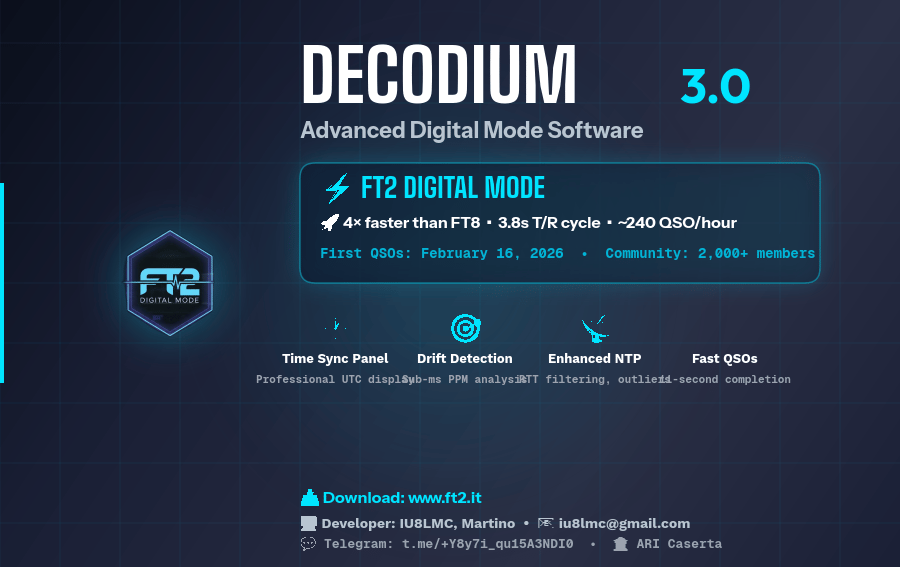
Although experimental FT2 implementations appeared during the later Decodium 3 era, FT2 becomes a core operating mode in Decodium 4. The protocol features approximately 3.8-second transmission cycles, dramatically reducing contact times compared with traditional FT8 operations.
This transforms Decodium from a decoder enhancement project into a protocol development platform.
For operators interested in contesting, portable operations, emergency communications, and rapid contact exchanges, FT2 represents a major step forward.
ASYMX and the End of Strict Clock Synchronization
Decodium 3 retained the conventional operating model used by FT8 and similar modes, where stations rely on accurate clock synchronization.
Decodium 4 introduces ASYMX, an asynchronous transmission system that removes the need for strict timing alignment. Operators can transmit without relying on NTP servers or GPS synchronization while maintaining successful decoding performance.
This innovation may prove particularly valuable for:
Maritime operators
Emergency communication deployments
Portable and field operations
Remote stations with limited internet access
For many operators, ASYMX represents the most revolutionary feature in Decodium 4.
User Interface and Operating Experience
Decodium 3 focused primarily on decoding efficiency.
Decodium 4 expands the operating environment substantially through:
Integrated Live Map functionality
Automatic Call Roster management
Modernized waterfall displays
Enhanced CAT control systems
Native Windows, macOS, and Linux support
Multi-rig and multi-instance capabilities
Apple Silicon native builds for modern Mac hardware
The software feels less like a specialized utility and more like a complete digital-radio workstation.
Platform Support
Another area of major improvement is platform compatibility.
While Decodium 3 supported multiple operating systems, deployment often required platform-specific workarounds or community-maintained builds.
Decodium 4 introduces:
Native Windows builds
Native macOS Apple Silicon support
Portable Linux AppImage releases
Improved installation and migration tools
This broader support lowers the barrier to entry for new users.
Performance Comparison
Feature Decodium 3 Shannon Decodium 4 Shannon
Core Language Fortran + Qt 5 C++ + Qt 6.11 + QML
Raptor Engine Yes Enhanced Raptor
Multi-Core Processing Limited Full OpenMP Parallelization
FT2 Integration Experimental/Limited Native
ASYMX Support No Yes
Live Map No Integrated
Apple Silicon Support No Native Version Native
Linux Distribution Community-Oriented Portable AppImage
Multi-Rig Operation Limited Supported
Future Extensibility Moderate High
Looking Forward
Decodium 3 Shannon demonstrated how advanced decoding algorithms could significantly improve weak-signal digital communications. Decodium 4 Shannon takes the next logical step by reimagining the entire operating environment around those decoding capabilities.
By combining the proven Raptor engine with a modern C++ architecture, native FT2 support, asynchronous operation through ASYMX, and a fully redesigned user experience, Decodium 4 positions itself as more than a decoder. It becomes a platform intended to support the next generation of amateur-radio digital communications.
Conclusion
The difference between Decodium 3 Shannon and Decodium 4 Shannon can be summarized in a single sentence: Decodium 3 optimized decoding, while Decodium 4 redefines the operating model.
Both versions share the same technical heritage and commitment to weak-signal performance, but Decodium 4 expands the project's scope dramatically. For users of Decodium 3, the transition to Decodium 4 offers not only faster and more efficient decoding, but also access to entirely new communication methods that could influence the future direction of digital amateur radio.